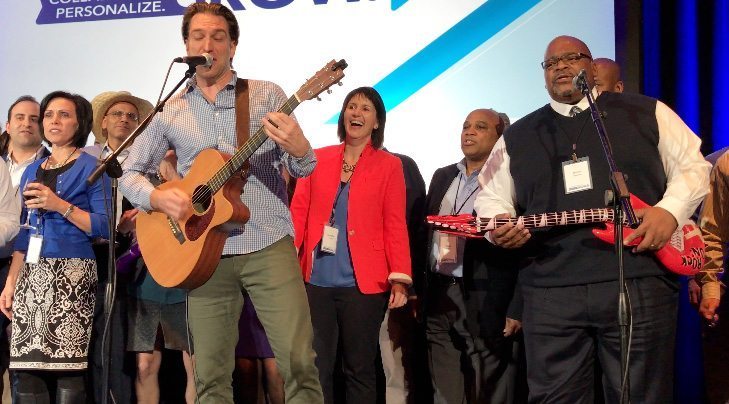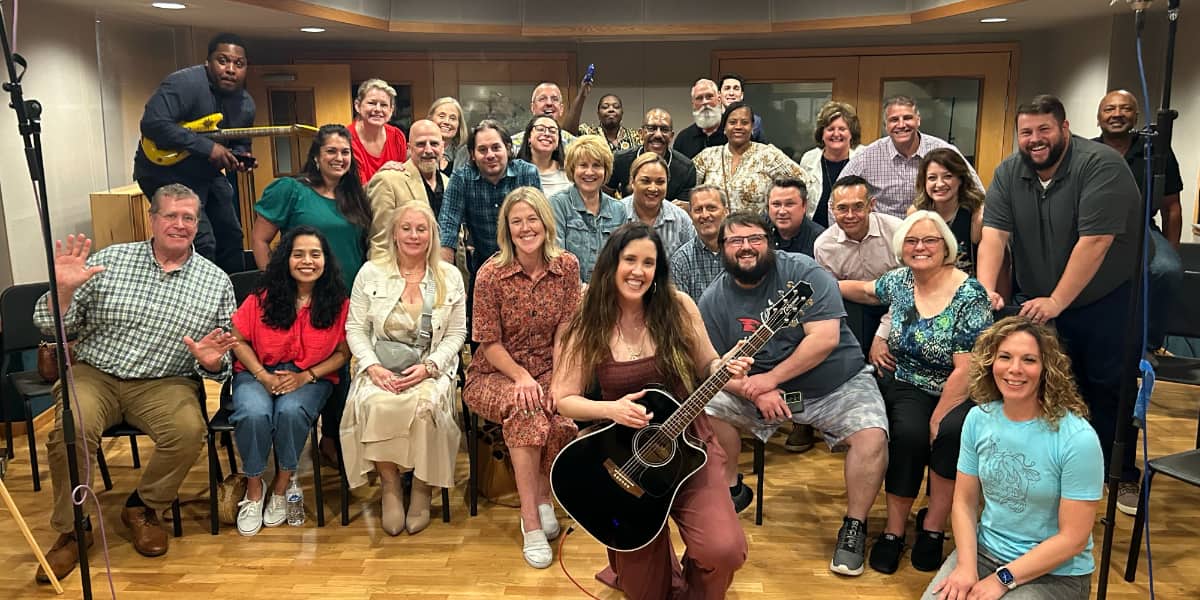
I’ve been doing this for a long time. Since 2008, my team and I have walked into more conference rooms, ballrooms, and video calls than I can count, and led people who swore they weren’t creative through the process of writing, performing, and recording real songs together. Somewhere along the way, I’ve learned a few things about what actually works when you’re trying to bring a group of people together, and just as much about what doesn’t.
This guide is everything I know about team building. Not just the music side of it, although that’s where my heart is and what we do best at Kidbilly Music. I wanted to put together the resource I wish existed when I got into this business: an honest, complete look at team building activities for work, why so many of them fail, what actually makes people connect, and how to choose the right one for your team, whether that’s music, an escape room, a volunteer day, or something else entirely.
Grab a coffee. This is a long one, but I promise it’s useful the whole way through.
What “Team Building” Actually Means Today
“Team building” used to mean something pretty narrow: a trust fall, maybe a rope course, an afternoon everyone dreaded. That version of team building still exists, and it’s part of why the phrase makes people groan when it shows up on a meeting invite.
But team building today shows up in a lot more places than the old model ever accounted for:
- Company conferences and industry summits
- New hire onboarding and department kickoffs
- Leadership off-sites and annual retreats
- Employee appreciation days and culture initiatives
- Association meetings where attendees don’t even work for the same company
The common thread isn’t the activity. It’s the goal: get a group of people who may or may not know each other well to actually connect and leave feeling more like a team than they did that morning. Done right, team building activities for work aren’t just a break from the “real” agenda. They’re some of the most valuable times a group spends together all year.
The problem is that “done right” is rare. Let me tell you why.
Why Most Team Building Falls Flat
I ask a lot of new clients about the last team building experience they had before they called us. Almost every time, there’s a wince before they answer.
One story has stuck with me. A client told me about an improv activity from a previous company event where they were put on the spot in front of their peers and asked to do something silly, something that made them genuinely uncomfortable. Nobody eased them into it. They were pulled into the spotlight, not drawn in. It had the exact opposite effect that team building is supposed to have. Instead of building confidence and comfort between coworkers, it built anxiety. People left that room more guarded with each other, not less.
If I had to boil down why most team building falls flat into one word, it’s this: forced.
Forced fun isn’t fun. Forced vulnerability doesn’t build trust; it erodes it. A good facilitator, in any kind of team building, takes the time to create an environment that’s safe, comfortable, and authentic before asking anyone to open up or step outside their comfort zone. That doesn’t happen in a fast, forced icebreaker where the goal seems to be checking a box rather than actually connecting people.
In my experience, most bad team building programs fail for the same underlying reason: the facilitator didn’t take the time to get to know the client first. They didn’t ask what this specific group needed, what their comfort levels were, or what “success” would even look like for them. They just ran their standard program and hoped it landed.
That’s the single biggest thing to watch for when you’re choosing any team building activity, music-based or not. Does this vendor actually want to understand your team, or are they just running you through a script?
The Full Range of Team Building Activities
Before I make the case for music (and I will, because I genuinely believe in it), I want to give you an honest rundown of the major categories of team building activities that are out there. Some of these aren’t what we do. That’s fine. My goal with this guide is to help you find the right fit for your team, not just sell you on mine.
1. Icebreakers
Short, low-commitment activities meant to get a group talking and lower the temperature at the start of an event. Think two truths and a lie, quick trivia, or a simple game tied to the day’s theme.
- Best for: the first few minutes of a meeting or conference when you just need people to talk before the “real” content starts.
- Watch out for: icebreakers that feel like homework. If people are groaning instead of laughing, it isn’t doing its job.
2. Problem-Solving Activities and Escape Rooms
Groups work together to solve a puzzle, crack a code, or complete a challenge under time pressure. Escape rooms have become one of the most popular versions of this.
- Best for: teams who like a little competitive pressure and enjoy puzzles. Great for smaller groups.
- Watch out for: activities that reward one or two dominant personalities while everyone else watches. A good facilitator makes sure every voice matters, not just the person who’s loudest or fastest.
3. Outdoor and Physical Activities
Ropes courses, field days, group hikes, sports tournaments. These lean on shared physical experience and a change of scenery.
- Best for: teams that already have some rapport and want to build on it, plus groups who genuinely enjoy being active together.
- Watch out for: weather, accessibility, and the fact that not everyone is equally comfortable or able to participate physically. This category can unintentionally exclude people if it isn’t planned carefully.
4. Games and Trivia
Structured games, quiz formats, and friendly competitions are often run digitally now for hybrid and remote teams.
- Best for: quick energy boosts, remote and hybrid teams, and groups who want something light and fun without a huge time commitment.
- Watch out for games that lean too hard on knowledge some people won’t have, like pop culture or sports trivia, which can leave parts of the group feeling like spectators rather than participants.
5. Creative Activities: Music, Art, and Storytelling
Groups create something together: a song, a piece of art, a story. This is where music team building activities live, along with things like collaborative painting or storytelling workshops.
- Best for: teams who want a genuine keepsake from the experience, something that reflects who they are, not just a generic “fun day.”
- Watch out for: creative activities that are really just performance in disguise. If people are still worried about being judged on skill, the creative process hasn’t actually done it’s job of lowering defenses.
6. Corporate Social Responsibility (CSR) and Volunteer Programs
Teams work together on a community service project, whether that’s a hands-on build day, a donation drive, or a partnership with a local nonprofit.
- Best for: organizations that want team building to double as a genuine contribution to their community, and teams who are motivated by purpose as much as fun.
- Watch out for: volunteer activities that are so logistically complex the “team” part gets lost in the shuffle. The best CSR team building programs still make space for connection, not just task completion.
Every one of these categories can be done well or done badly. The activity itself matters less than you’d think. What matters is the same thing I mentioned above: whether the people running it actually understand your team and your goals, or whether you’re only getting a one-size-fits-all program.
Deep Dive: Music-Based Team Building
Alright, here’s where I get to talk about what we actually do, and why I believe it works better than almost anything else out there for building real connections.
What a Session Actually Looks Like
Every session starts with a conversation about creativity, not an instrument. We’re all inherently creative, even though most adults will tell you flat out that they’re “not creative people.” So we start by drawing a parallel between songwriting and any other kind of problem-solving. Writing a song and solving a business problem use the exact same muscles. Problem-solving is creative. Once people understand that, the pressure comes off immediately, because now they’re not “the non-musical person in the room.” They’re just doing what they already do at work every day.
From there, here’s roughly how it unfolds:
- We do a lot of pre-program work before we ever walk into the room, developing the questions we’ll ask to get the conversation going about what the song will be about.
- As people answer those questions and trade ideas, we document everything. That becomes the raw material for the lyrics.
- Because lyrics are really just stories, about who we are, what we do, our shared experience, and what we care about, the group is building the song’s content before they even realize that’s what’s happening.
- By the time we start plugging those ideas into an actual song structure, everyone in the room is already invested. They’ve been part of the process from the first question. So there’s a real sense of ownership by the time music enters the picture.
- Our songwriter facilitators lead the actual music making and help everyone feel comfortable contributing, whether that’s a lyric, a melody idea, or just enthusiasm. Nobody is singled out or put on the spot to perform.
- We finish by singing and recording the song together as a group.
Everyone grows up around music. Once people are in the process, they realize how familiar and accessible it actually is. It ends up feeling like an out-of-the-box experience that’s somehow completely in the box: natural, easy, and honestly kind of obvious in hindsight.
Why Music Works When Other Activities Don’t
Music combines two incredibly powerful elements: melody, which conveys emotion, and lyrics, which convey a message. Put those together, and you get something that creates resonance and memory in a way that almost nothing else does.
Here’s a simple way to think about it. You may not remember where you left your car keys this morning. But you could probably sing twenty or thirty songs from memory right now, word for word, without even trying. Songs are deeply felt and deeply internalized in a way that a slideshow, a lecture, or even a well-run discussion just isn’t.
That same effect applies to team building. The song a group creates together becomes part of that same deeply felt, deeply memorized experience. Clients tell us all the time that the programs, and specifically the songs they wrote, live on long after the actual event is over. People sing them at future meetings. They reference lyrics in emails. That’s not something a typical afternoon activity leaves behind.
What People Get Wrong Before They’ve Done It
The number one misconception I hear before a session is that people think they’re going to have to “perform,” that there’s some arbitrary spotlight moment coming where they’ll be judged. That fear is almost always the biggest barrier going in.
What actually happens is the opposite. The program pulls people in gradually, meeting everyone in their comfort zone first, then slowly building buy-in through conversation, through answering questions, through sharing ideas as the process unfolds naturally. By the time we’re finished, I can’t tell you how many times someone has said some version of, “I honestly can’t remember what I was so worried about.” Once it starts, it feels natural. That’s the whole point.
How to Choose the Right Team Building Activity for Your Team
Not every group needs the same thing, and honestly, not every group needs music, even from us. Here’s how I’d think about matching the activity to the situation, based on what we’ve learned running programs for groups ranging from five people to five thousand.
Start With Your Goal
- Team bonding within a single team or department: you want something that goes deeper, with real time for conversation and connection, not just a quick energizer.
- A conference or large event where you need everyone engaged at once: you want something that scales without losing the personal feel.
- A specific milestone, like a product launch, company anniversary, or merger: you want an activity that can actually reflect that moment, not a generic “fun day” that could apply to any company.
- Employee appreciation or culture building: you want something that feels like a genuine gift to your team, not another mandatory event on the calendar.
Match the Format to Your Group Size and Time
This is exactly how we structure our own programs, and I think the logic holds up regardless of which vendor or activity you choose:
- Team building focused sessions with time for real depth, 1.5 to 3 hours: This is the sweet spot for programs where multiple teams each create something of their own, like our Team Songwriting Programs. Larger groups will need the most time, simply for the logistics of breaking into teams and coming back together to share what they made.
- Conference general sessions where everyone stays together, 30 to 90 minutes: If your goal is a single shared experience rather than multiple team outputs, a shorter format designed for the whole room works better. That’s the model behind our Conference Programs. There’s still small-group work built in, but everyone contributes to a single collective result instead of splitting into competing teams.
- Keynote style sessions: When a client specifically needs a keynote, we go deeper into takeaways, providing more insight into how to harness creativity in the workplace. Our Keynote Speaker program is built for that.
- Remote and distributed teams: Distance doesn’t have to mean disconnected. Our Virtual Team Building programs bring the same live, interactive experience to teams no matter where they’re logging in from.
- Groups that specifically want drumming: Drumming isn’t the core of what we do, but we get requests for it from clients who want something deeper than a typical drum circle franchise offers. We bring the same pre-program preparation and goal-setting conversation to our Drumming Programs that we bring to everything else. Clients often come to drumming looking for a specific metaphor; working in rhythm, staying in sync, moving to the same beat. This can work as a guide and catalyst for how they want their team to operate.
The honest truth is, we’re constantly customizing our program structure to fit what specific clients actually need. If you take one thing from this section, let it be this: a good vendor should be asking you these questions, not handing you a fixed menu and asking you to pick a number.
When to Consider Something Other Than Music
I’ll be straight with you. I think music-based team building works for pretty much any group. We’ve worked across nearly every industry and every type of role, and it’s rare that we walk away thinking it wasn’t a fit for the people in the room.
Where it doesn’t work is almost never about the group itself. It’s about planning constraints, like an agenda that’s simply too tight to do the program justice, or other logistical challenges that would make it hard for us to deliver a program we’re proud of. In those cases, we’d rather be honest and recommend waiting until the timing is right, rather than run a version that doesn’t represent what we do best for clients or ourselves.
How to Plan a Team Building Event: Step-by-Step Checklist
Whatever activity you land on, music or otherwise, here’s a practical checklist for planning it well.
- Define your goal first, before you pick an activity. Are you building connections within one team, celebrating a milestone, energizing a conference, or something else? The goal should drive the choice of activity, not the other way around.
- Set a realistic budget. Include the activity cost, space, AV or technical needs, catering (if relevant), and any travel for remote team members joining in person.
- Pick your timeframe honestly. Don’t squeeze a program that needs ninety minutes into a thirty-minute slot because that’s all the agenda has room for. A rushed program is often worse than no program at all.
- Get leadership buy-in early. If leadership treats the activity as optional or unimportant, your team will pick up on that instantly, and it undercuts the whole point.
- Communicate expectations to participants ahead of time. People show up more open and less anxious when they have a general sense of what’s coming, even if the specifics are a surprise. Nobody likes being blindsided into something that feels performative or high-pressure.
- Confirm logistics well in advance: room setup, AV, group size, and any accessibility needs. This is exactly the kind of pre-program planning that separates a smooth day from a stressful one.
- Ask your vendor how they prepare. More on this in the next section, but it’s one of the most important questions you can ask before booking anyone.
- Build in time for the reveal or wrap-up. Whether it’s a performance, a shared output, or just a group debrief, don’t rush the ending. That’s often the part people remember most.
- Plan for what happens after. A great team building activity shouldn’t just live in that room for one afternoon. Think about how you’ll keep the momentum going, whether that’s sharing photos and recordings, referencing the experience in future meetings, or simply following up on what people said they wanted more of.
Common Mistakes to Avoid
I’ll admit this might sound a little confident, but we do so much pre-program planning and coordination that we genuinely don’t run into these mistakes when we show up for a session. That said, I’ve heard plenty of stories from clients about previous vendors, and I’ve watched other companies make these mistakes over the years. Here’s what to avoid:
- Skipping the discovery process. If a vendor is willing to book you without a real conversation about your goals, your group, and your concerns, that’s a red flag. We’re careful to align expectations with what we deliver and spell out every logistical need in our proposals and contracts up front, precisely so nobody is surprised on the day of the event.
- Underestimating time needs. Whether it’s travel time, setup time, or the activity itself, padding your schedule too thin is one of the most common and avoidable mistakes planners make.
- Treating group size as an afterthought. What works beautifully for twenty people can fall apart for two hundred without real planning for how teams will break out and come back together.
- Not asking about the vendor’s planning process. This is the single most important question most clients or planners never think to ask: “What is your pre-program planning process?” You want to hear that they’ll take time to understand who your people are and how to communicate with them, not just show up and run a script. A vendor who can’t answer this clearly probably doesn’t have much of a process to begin with.
- Forgetting to set expectations with participants. Even a great activity can fall flat if people walk in with no idea what’s coming and feel ambushed.
How to Measure Whether It Worked
“Did it work?” is a fair question, and a lot of planners have to answer to leadership afterward with more than just “everyone seemed to have fun.” Here’s how I think about it, both in the room and afterward.
In the Room
Genuine fun is the starting point. That might sound simple, but it’s the real signal. Once people are actually having fun, they’re engaged, and that’s when the deeper impact begins. In all our years doing this, we’ve had one program that fell flat, and it was early on, back when we hadn’t yet learned to ask the right questions up front to understand a client’s goals. Additionally, a good facilitator reads the room and adjusts pacing and tone for a group that’s getting off to a slow start. It should always get to where it needs to go, even if it takes a few extra minutes to warm up.
After the Event
A few signs your team building activity actually worked, beyond the day itself:
- People reference it later. If the experience shows up in future conversations, meetings, or emails, it stuck.
- The organization asks for it again, sometimes in a different office or department entirely. We had one client book us three separate times in a single year, once each for their London, New York, and Boston offices, because word had spread internally about the first session. That’s the kind of result that tells you something actually landed.
- There’s a tangible keepsake. A recording, a song, photos, something people can point back to. That’s part of why we always record what a group creates. It gives the program life beyond the day of the event.
- Team dynamics visibly shift. This one takes longer to notice, but it’s the most important. Do people who didn’t know each other well before the session seem more comfortable together now? That’s the real outcome you’re hoping for.
Real Results: What Clients Say
I could tell you all day that this works, but I’d rather let the people who’ve actually sat in the room say it themselves. Here’s a small sample of what clients have told us after a program:
- Disney Imagineering: “This songwriting process is a clever way to really reach the heart of your team. In one word, magic. This music team building activity is powerful, and I have already recommended it to others.”
- Southwest Airlines: “Our goal for this activity was to find an enjoyable way to build teamwork and camaraderie within our department. Kidbilly far surpassed our expectations.”
- Pfizer: “Six months later, this is still showing a valuable impact. The song was picked up by the communications team, and they plan to use it as part of an internal event. We are using it in team meetings to bring back the positive feelings and stay focused.”
- Honeywell: “Our large group of aerospace engineers was doubtful about getting into this type of program. But once we got started, the participation and enthusiasm were contagious. The end result: 275 people on their feet, singing as one.”
- Bayer Healthcare: “Billy and his team were able to get the groups really engaged to celebrate the important work we do together. We had great fun, and most rewarding was that the results were surprisingly good. We are still talking about it.”
That Pfizer example is a great one to sit with for a second. Six months later, a song from a single team building session had been adopted by their communications team and was still being used in meetings to refocus people. That’s not only a “fun afternoon” outcome… that’s a business outcome!
Frequently Asked Questions
What is music-based team building, exactly?
It’s a team building activity where a group writes, performs, and records an original song together, guided by professional songwriter facilitators. The process is built around conversation and shared storytelling first, with the actual songwriting and performance woven in gradually so nobody feels put on the spot.
Do I need to be able to sing or play an instrument to participate?
No. This is probably the question I get asked most, and the honest answer is that some of our best sessions have been with people who were absolutely certain they had “no musical ability” when they walked in. The process is built to work for music novices and skilled musicians alike.
How long does a music team building session take?
It depends on the format. Sessions focused on multiple teams writing their own songs typically run 1.5 to 3 hours. Conference-style sessions, where one large group creates a single song together, usually run 30 to 90 minutes. We’ll help you determine the right length for your group and goals.
How many people can participate?
Our programs scale from as few as 5 people up to groups of 5,000 or more. Group size changes the format and timing, but not whether the program works.
Can this work for a fully remote or hybrid team?
Yes. Our virtual programs deliver the same live, interactive experience online, not a prerecorded activity or a game, so distributed teams can genuinely create something together in real time.
How far in advance should we book a team building activity?
As early as your planning timeline allows. The amount of pre-program planning that goes into a great session, understanding your team, your goals, and your agenda, takes real time. The earlier we can start that conversation, the better the end result.
What’s the difference between a music team building session and just hiring a band for our event?
A band performs for you. Music team building is something your team actually creates, together, with their own words and their own story. The output isn’t entertainment you watch. It’s something you made, which is exactly why it tends to stick with people so much longer than a performance would.
How do I know if music-based team building is right for our group?
If your goal is a genuine connection, not just a fun distraction, it’s almost always a fit. The exception tends to be logistics, such as an agenda that’s too tight to do the program justice, rather than anything about the group itself. If you’re not sure, that’s exactly the kind of thing worth a quick conversation before you commit to anything.
Ready to Bring Music Into Your Next Team Building Event?
If you’ve made it this far, you already know more about team building and about how we specifically approach it than most people who book us. That’s on purpose. I’d rather you go in with clear eyes and choose the right fit for your team than sell you on something that isn’t.
Here’s where to go next, depending on what you’re planning:
- Multiple teams want each to create their own song: check out our Team Songwriting Programs.
- A conference or general session where everyone stays together: look at our Conference Programs.
- Need a speaker who does more than talk: see our Keynote Speaker program.
- A remote or hybrid team spread across locations: our Virtual Team Building programs are built exactly for this.
- Want the energy of drumming with real depth behind it: take a look at our Drumming Programs.
Or if you’d rather just talk it through first, that’s what I’m here for. Reach out and let’s figure out what will work best for your team.